The deceptive lure of the fresh start on a blank page
I’ve been inspired today to finally share this ‘deleted scene’. I included a version of this essay in drafts of my memoir ‘Nest’ right up until the last minute. It was a darling I knew should be killed off, but I left it to my editor to wield the axe! The idea remains though, seamlessly embedded in the narrative, I like to think.
Today I’m thinking about beginnings for #MayontheMove2026, so I finally tweaked this darling I love so much to share with you.
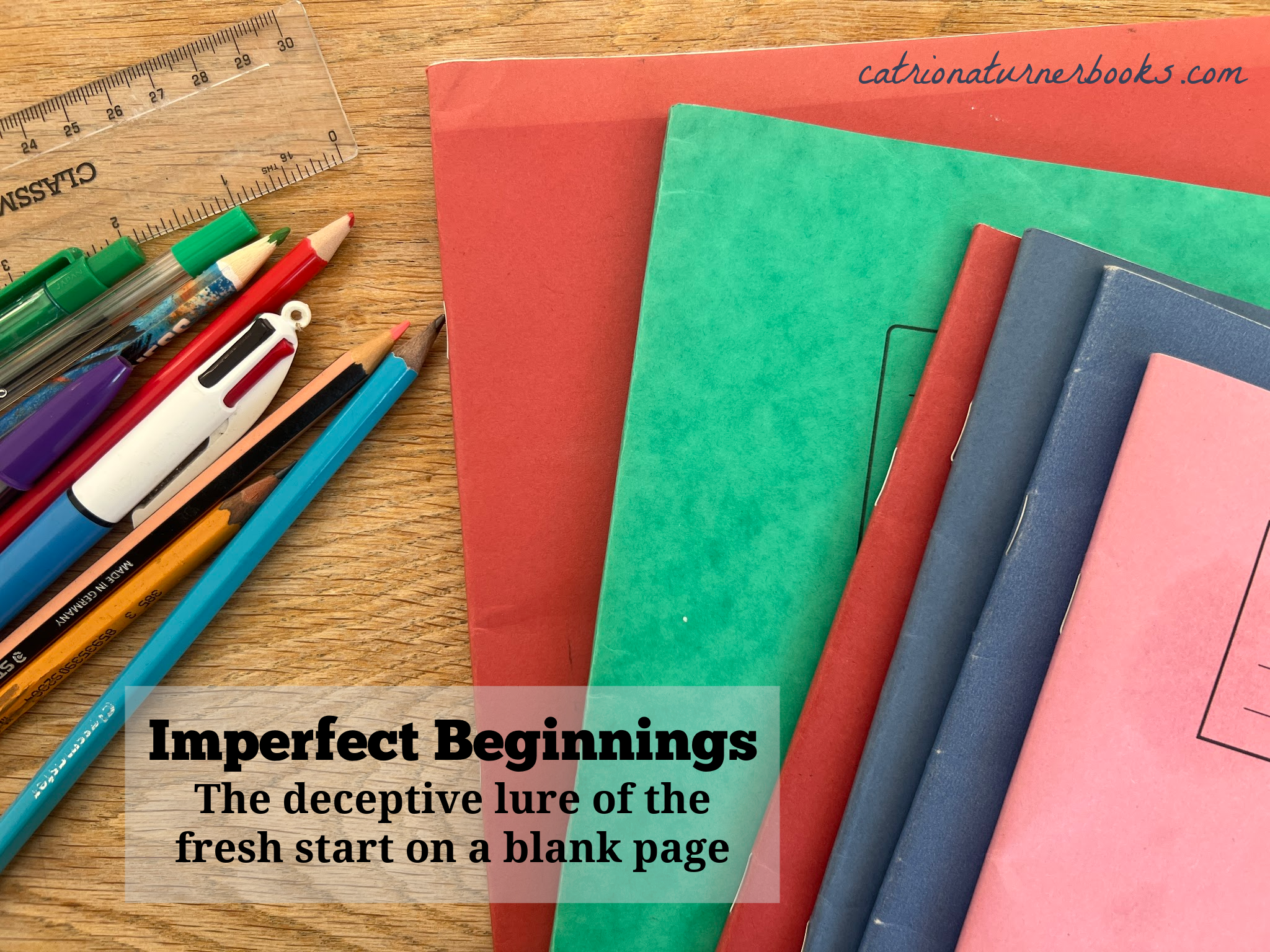
My schooldays were defined by jotters. They were blank workbooks of lined, squared, or plain paper, and from the first day of Primary One, we used a jotter in class every day. They were a chunky rectangle, probably a little bigger than A5, bound with a couple of staples and a soft sugar paper cover in muted shades of orange, buff, green, or blue, the satisfying texture rough but somehow also fleecy. There would be a box with lines for my name, class, subject, and teacher, and underneath, the logo of Strathclyde Regional Council, or later, Inverclyde District Council, as organisation of education budgets shifted.
Sometimes the teacher handed out a smaller jotter, like a mini workbook, with slim pages for spelling words, times tables, or new vocabulary. Those were my favourite, because they demanded no scrawling sentences, but neat, organised lists, ordered words that could hardly go wrong.
I miss jotters. When I started teaching, I still handed out jotters. Those didn’t have the council branding, and they were A4 size, but bound the same way, with staples and blue sugar paper covers. When I moved to another school, they had moved on to binders and insubstantial loose-leaf paper. In some schools, my children only ever had pre-printed worksheets for homework where they added their name in a random corner, with arbitrary blocks of lines for context-free answers rather than instructive full sentences. In our jotters, we organised our ideas on the page, date in the margin, heading double underlined with the help of a ruler.
Jotters were more solid than simple reams of paper. The jotter in my hand at the start of the school year was weighted with expectation. I would be filling these pages, and more. On my desk, in my hands, the sturdy sensation of a year of work ahead, the start of something substantial.
On the first page I had a firm but giving surface in front of me. I would glide my hand across it, soothed by its silky sleekness. It was comfortable and satisfying to write with the yielding, neatly bound stack of papers underneath. Then I had to turn the page and write on the other side, with just the hard desk underneath. Maybe I would bend the cover of the jotter, so that I could fold the whole thing back on itself and try to emulate the feeling from that first special page.
Because that was the best thing about a new jotter: its essential newness. With the solid reams of paper underneath, the satisfying first fold back of the cover with my name in my neatest block capitals on the front, I would hesitate before making a mark. This jotter was gleaming white with possibility, a field full of fresh snow, all for me, to create anything, to learn anything. I didn’t want to break the spell.
This jotter would be different from the rest. This jotter would be filled with all good things. Every mark would be well-placed, free from errors. There wouldn’t be unfinished paragraphs, or crossings out. Not one page of this jotter would be sullied with the teacher’s red ink except a circled ‘VG!’, or would get torn, or get damp on a rainy day so that even when dry the paper would stay crinkly, or coffee-stained from doing homework on the kitchen table. This jotter wouldn’t have words squeezed in awkwardly at the end of a line or the bottom of a page.
Eventually, I would lift the pencil or pen, and make my mark, the date perfectly aligned in the top left margin, the heading neatly composed and underlined with a ruler. From this point on only my best handwriting would appear in this jotter. But I’d have made my mark, and broken the spell, and the new jotter’s journey into messy imperfection had begun.
There’s a whole shelf of empty notebooks in my study. It’s the easiest gift to give someone who writes. Not just because it answers the question of something they’ll use, but also because of the variety of special, beautiful notebooks, with tactile fabric covers, high-quality paper, or leather binding. Even though I have that shelf, every time someone gives me a new notebook, I’m delighted with it. I lift the cover, flip through the pages, and there I am again with that pristine sense of possibility. What will I use this one for? It could be the journal that helps salve my soul, or the bullet journal that makes life streamlined and effortless. It could be the notebook I carry and fill with word sketches of the world as I see it, bringing future readers to the place where I sit with perfect telepathy. It could be the collection of notes that lead to a thrilling novel or a meaningful memoir, or the repository for research that creates a vivid setting.
All those notebooks sit on the shelf, holding perfect possibility, until they get used for inadequate words in rushed handwriting, half-formed thoughts and rambling sentences. No wonder I keep buying cheap pads of paper rather than breaking into the beautiful hardback journal with hand-tooled leather I got for Christmas.
Some people say they have a stationery fetish. Maybe I have a fetish for the blank page, for what could be, the perfect outcome, the imagined prose.
What could be better than that, than the blank jotter?
Come to that, what could be better than a fresh start, in a new location, a new house, a new job or project – the chance to get everything right this time?
There is something better than a blank jotter.
It’s a jotter filled with work, from cover to cover: a full term of accomplishment.
While a fresh, unmarked jotter page moves in a smooth, unyielding arc, the written-on pages turn with ease. They’ve been softened, moulded by the words, been folded back and forward as the meaning becomes clear. The pressure of pen nib or pencil point has tenderised the paper, made it malleable. If I’ve been leaning too hard, the pages turn with a crinkle, the marks have made rows of indentations, mini creases across the page.
I can flip back through everything in the jotter that I’ve learned, everything in the notebook I’ve achieved, all the sentences I’ve created. Each marked page leads to the next one: imperfect, yes, messy – and full of momentum. Without the first imperfectly marked page there wouldn’t be the last page filled, and all the ones in between. It makes visible the process between first markings and the last page, the tangible outcome built on practice.
A filled jotter is thicker, denser. The pages have more dimensions. The indentations give depth and weight that wasn’t there before, and the pages bulge, gorged with meaning. They may be dog-eared, folded and fiddled with; there may be doodles in the corners, crossings out, remarks from the teacher, corrections and redrafts. The covers pull at the staples to contain it all.
The perfectly aligned date in the margin, the neat, underlined headings: forgotten. A squiggly line was quicker than finding the ruler, the date was added as an afterthought. There are coffee stains, and warped paper that got damp, and pages missing because I needed to tear one out and send a note.
It’s a mess, and it is full. When I hold it in my hands I feel the amplitude, the completeness of something that has been worked on to the end, without getting lost or abandoned. Everything has been done. I am holding a body of work, a retrospective of practice and effort. The pages hold perseverance, perhaps even reluctance, but always prove that somewhere, at some point, I showed up, even if I made a mess of it.
(The next jotter will be even better, mind you.)
I’m getting better at looking back at the full jotters of my life, at not dismissing them to dive in to the blank fresh start, the new beginning, and all the reinvention it could represent. Better to build on what’s gone before. I’ve stopped saying that the next country will be where I’ll get everything right. None of what comes next can happen without what came before, without the first imperfect mark on the page.